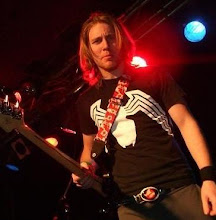
And now, last but definitely not least, it's Metals turn. And away we go...
You could argue that metal started back in the late 60's and early 70's, with bands like Cream, Hendrix and Led Zeppelin. By incorporating heavy guitar riffs with the style of blues and jazz, They paved the way for metal music, along with progressive bands like Rush, and even psychedelic bands. Like punk, however, metal is more than just music. It's a way of life.
By the mid 70's, early metal had found a home with artists like Black Sabbath and Deep Purple. Keeping strong into the 80s, bands like KISS, Iron Maiden, Metallica, and Slayer were becoming increasingly popular, fueling the genre that is metal. As the times progressed, the earlier metal acts gave way to new genres of metal, ranging from speed metal to death metal (we'll discuss sub-genres at a later date) and new artists.
Metal bands threw away the jazz and blues influence for the most part, and replaced it with the speed and intensity of punk music. Typically consisting of a drummer, bassist, guitarists, vocalist and sometimes a keyboardist. More than often, especially in the current times, metal vocalists tend to lean towards less melodic lyrics, replacing the melodies with aggressive screaming. There are bands who strictly prefer melodic vocals though, or even a mix of the two. More often than not, instrument tuning will be taken down a notch.
Metal was often associated with Satanists and the devil, but mostly by people who feared the music and were looking for an excuse to de-popularize it. However, there were those bands like Black Sabbath who adopted this generalization and used it to their advantage, and cleverly so. Metal was just about doing what you want, not what you were told (much the same way as punk) and it still is today.
So, now we have a quick idea of what the 3 genres consist of. Now we have to figure how to balance them, in all aspects. This needs to be a group effort if it's going to work, right? Right. So we'll have to do it together. Next time, we'll begin a list of aspects from the 3 genres we can use to create a new one. It's going to be a long list (or atleast, it SHOULD be a long list) and Ideas are, as always, welcome.
Showing posts with label punk. Show all posts
Showing posts with label punk. Show all posts
Monday, May 19, 2008

Thursday, May 15, 2008
Beginnings Pt.1
Here, we're going to discuss the roots of the genres in question. Now defining a genre is not easy work and as with anything worth discussing, there are going to be arguments on what is considered what, right down to the tee. Lets start with Progressive Rock shall we? Follow along, and feel free to make notes to help out along the way. Truly defining anything takes teamwork. After all, a million people are smarter than one. Lets begin with a brief description of progressive rock.
Progressive rock found its roots in the late 60s and came into prominence around the early 70s, originating from the fantastic land of England. It was (and still is by many) considered to be one of the most sophisticated forms of rock music, influenced by classical music, various forms of rock music and jazz.
The concept of progressive rock seems to have been born of the desire to simply progress, an (often) basic human desire. More specifically, to progress the rock music of the 60s into something it had never been, something more technical, and to steer away from the mainstream simplicity of what it was. Not to say that ALL of the 60s rock bands were simple, or anything close to mainstream (especially by the standards of today). But there was a need to grow. To borrow from other styles, to create something new. Something faster, something constantly changing (and I mean CONSTANTLY, be it mid song or mid album), something you can listen to time and time again and hear something you missed the first, second, or ninth time around.
Combining the sophistication of jazz, the melody of rock n' roll, melodies reminiscent of classical music, and often pushing technique to the limit, progressive rock (lets call it just call it prog from now on) was created. Now let's talk about composition and instrumentation.
Many prog bands adopted the idea of the concept album. Basically, albums that follow either some kind of story or, well, concept. Sometimes complete with in-song narratives in addition to the main lyrical content. Bands such as Rush, Genesis, Pink Floyd and Yes (to name a few) were fans of the concept album. Many prog bands utilized electronic instruments as well, increasing in popularity around this time. They often veered from standard time signatures and tempos. To write progressive rock music, one had to almost master their instrument (I know, it's impossible to literally master an instrument, no body's perfect) which not every musician is capable of. There was often plenty of solo sections so that the players could showcase their talent. And it wouldn't be surprising to to hear songs upwards of 20 minutes. That was and, still is, the style of prog.
Now, this was a very brief description of progressive rock, there are some great websites out there with tons of information, so check 'em out if you'd like to learn more. My description was just to get the little ball, known as Prunkle, on the roll. If you're still with me, a little description of punk rock is coming up next. Again, any descriptions or ideas are totally welcome so comment away. We're in this together.
Progressive rock found its roots in the late 60s and came into prominence around the early 70s, originating from the fantastic land of England. It was (and still is by many) considered to be one of the most sophisticated forms of rock music, influenced by classical music, various forms of rock music and jazz.
The concept of progressive rock seems to have been born of the desire to simply progress, an (often) basic human desire. More specifically, to progress the rock music of the 60s into something it had never been, something more technical, and to steer away from the mainstream simplicity of what it was. Not to say that ALL of the 60s rock bands were simple, or anything close to mainstream (especially by the standards of today). But there was a need to grow. To borrow from other styles, to create something new. Something faster, something constantly changing (and I mean CONSTANTLY, be it mid song or mid album), something you can listen to time and time again and hear something you missed the first, second, or ninth time around.
Combining the sophistication of jazz, the melody of rock n' roll, melodies reminiscent of classical music, and often pushing technique to the limit, progressive rock (lets call it just call it prog from now on) was created. Now let's talk about composition and instrumentation.
Many prog bands adopted the idea of the concept album. Basically, albums that follow either some kind of story or, well, concept. Sometimes complete with in-song narratives in addition to the main lyrical content. Bands such as Rush, Genesis, Pink Floyd and Yes (to name a few) were fans of the concept album. Many prog bands utilized electronic instruments as well, increasing in popularity around this time. They often veered from standard time signatures and tempos. To write progressive rock music, one had to almost master their instrument (I know, it's impossible to literally master an instrument, no body's perfect) which not every musician is capable of. There was often plenty of solo sections so that the players could showcase their talent. And it wouldn't be surprising to to hear songs upwards of 20 minutes. That was and, still is, the style of prog.
Now, this was a very brief description of progressive rock, there are some great websites out there with tons of information, so check 'em out if you'd like to learn more. My description was just to get the little ball, known as Prunkle, on the roll. If you're still with me, a little description of punk rock is coming up next. Again, any descriptions or ideas are totally welcome so comment away. We're in this together.
Tuesday, May 13, 2008
What is a Prunkle and where can I get one?
Prunkle is something I've been looking into for a pretty long time. Here's the official definition of the word Prunkle... as created by myself.... about 15 seconds ago:
A complete and balanced sub-genre of music consisting of Progressive Rock, Punk Rock, and Metal.
So voila! Add Prog, Punk, and Metal... a few lightening fast guitar leads here, a few trashy four chord progressions there, toss in some drop D tuning and heavy, galloping palm muting, a pinch of high vocals, a pinch of gibberish ranting (just to start)... bake at 425 for 20 - 25 minutes and there you go.
BUT... that's only a minuscule taste of what I like to call Prunkle. That's why this blog exists. Over the next while, I'll be researching into what it takes to create a genre, and I expect all of you musicians or music lovers alike to speak your minds.
Enjoy
A complete and balanced sub-genre of music consisting of Progressive Rock, Punk Rock, and Metal.
So voila! Add Prog, Punk, and Metal... a few lightening fast guitar leads here, a few trashy four chord progressions there, toss in some drop D tuning and heavy, galloping palm muting, a pinch of high vocals, a pinch of gibberish ranting (just to start)... bake at 425 for 20 - 25 minutes and there you go.
BUT... that's only a minuscule taste of what I like to call Prunkle. That's why this blog exists. Over the next while, I'll be researching into what it takes to create a genre, and I expect all of you musicians or music lovers alike to speak your minds.
Enjoy
Subscribe to:
Posts (Atom)